Identifying a Sliding Bevel's Region of Manufacture
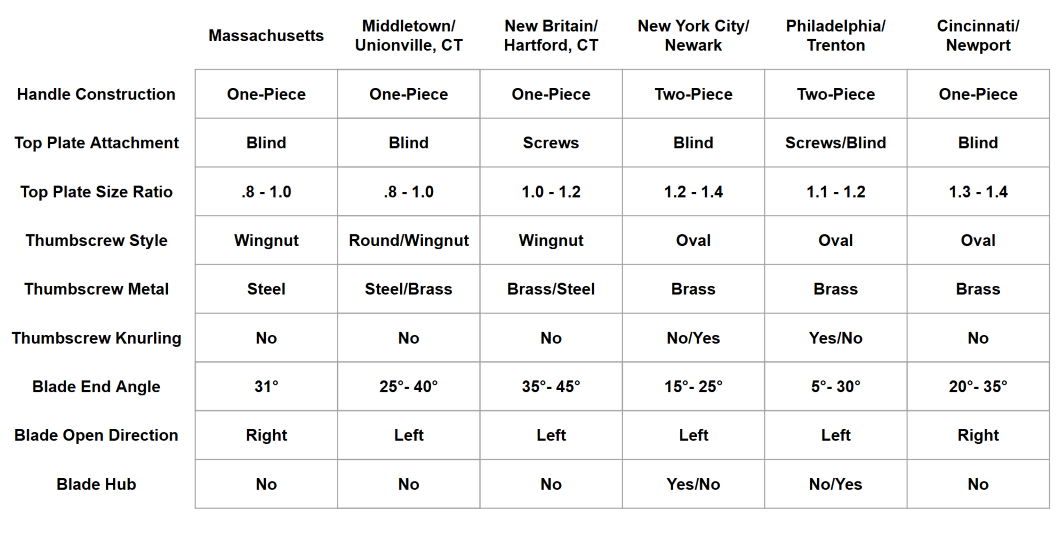
There are 9 different design elements found on 19th century sliding bevels that can be diagnostic in determining which of 6 different regions a bevel was produced in. Narrowing down the region can assist in determining a likely manufacturer if the bevel is unmarked. Keep in mind that this chart is not foolproof. There are unmarked bevels (and occasionally marked outliers) which will only follow some subset of the 9 diagnostic and not be a perfect match for a singular region. The preponderance of evidence should be used when making a determination.
This chart only covers non-patented bevels made before 1900 with the traditional thumbscrews found in the chart (excludes levers, thumbwheels, slotted screws, cast designs, etc.) Remember that thumbscrews and blades can be replaced or modified and care should be taken that they are original before using this information. This quick glance chart shows the general values for each diagnostic/region combination. If two values are listed, the first is the more common. Below you will find explanations, photos, and exceptions for each diagnostic. At the end of the page is information pertinent to each region. Visit the Early Bevel Makers page to view the makers for each region and diagnostics for example bevels. Full Size Chart
1 - Handle Construction
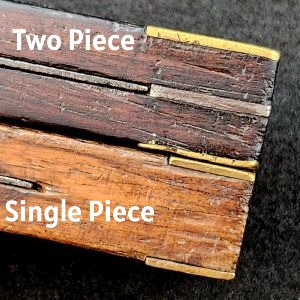
Handles were constructed in either one part or two parts. Single piece handles are one solid piece of wood which has a kerf sawed along its length to receive the blade. Often the bottom of the kerf is angled to match the angle of the end of the blade. The two-part handles use separate pieces of wood for the front and back of the handle. A thin piece of brass is sandwiched between the pieces at the bottom to create the kerf for the blade and riveted together. Sometimes the brass piece is angled to match the end angle of the blade. These two styles appear to simply be manufacturing preference. Single piece handles were probably easier to make, while two-piece handles allowed for more efficient use of wood. Without exception, Philadelphia and New York makers used two-piece handles and New England and Ohio makers used single piece handles.
2 - Top Plate Attachment Method
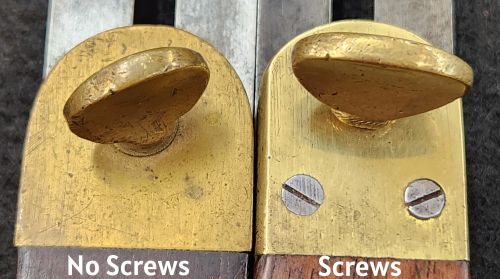
There were two main methods of attaching top plates. First is using a pair of screws. The other is casting pegs into the backside of the plate then pressing the plate into corresponding holes in the handle. Both steel and brass screws were used, but don’t really correspond to geographic regions. Almost all Philadelphia makers used top plate screws. Some Connecticut makers did as well. A few individual Cincinnati bevels are known with screws, although these appear to be outliers.
3 - Top Plate Size Ratio
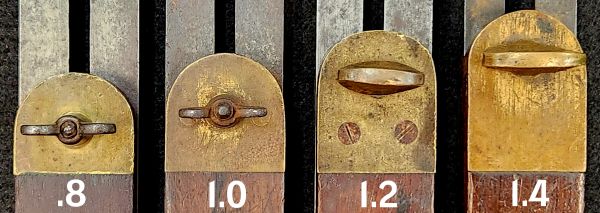
In general, New England bevels have the shortest top plates, while Ohio bevels have the tallest. The best way to objectively categorize this is by using a ratio of height divided by width. The chart shows the range of ratios that one is likely to find for that region. Simply divide the height of the plate by the width (use any units you prefer as the divided result will always be the same) to get a ratio which can be compared to the chart. Keep in mind that the ratios provided are guides, not gospel. There is some natural manufacturing variation that may take a particular bevel out of the range shown in the chart.
4 - Thumbscrew Style
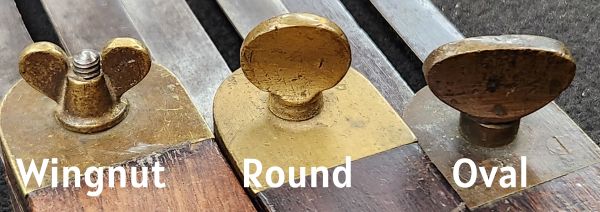
There are three thumbscrew profiles. Wing nuts are probably the most common style. Wing Nuts screw onto a separate threaded bolt that passes through the handle and blade from the back. Except for a single Philadelphia maker, all wing nut bevels are from New England. The other two profiles are referred to as round or oval and have an integral threaded shaft that screws into the bevel handle. Round thumbscrews (which are about as wide as they are tall) are unique to some Connecticut makers. Oval thumbscrews are ubiquitous on Philadelphia bevels as well as New York and Ohio bevels.
5 - Thumbscrew Metal
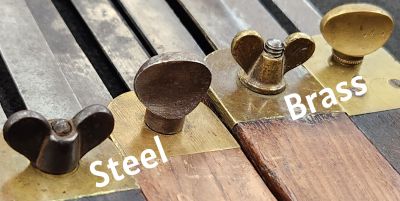
Thumbscrews, regardless of profile, are made of either brass or steel. Only New England bevels used steel or brass. Other regions used exclusively brass, the only exception being A & E Baldwin in New York.
6 - Thumbscrew Knurling
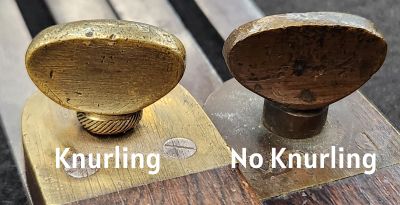
Knurling, fine decorative lines at the base of oval thumbscrews, was highly prevalent on Philadelphia bevels as well as some New York bevels. New England and Ohio bevels are completely devoid of this feature. Knurling was a purely decorative feature and added extra manufacturing steps. Knurling can take several forms, from simple vertical lines, to beautiful, angled roping on curved beads.
7 - Blade End Angle
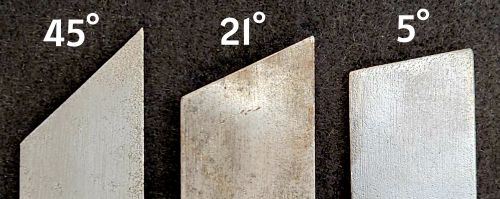
The angle cut at the end of the bevel blade is instructive. In general, Philadelphia and New York bevels have very shallow angles, while New England and Ohio bevels have steep angles. I believe this angle exists simply to give a positive stop when stowing the blade in the handle. This theory is because the blade kerf on most bevels is cut to match the blade. There would be no need to do this extra manufacturing step if this were not the main purpose. Be aware that sometimes users shorten blades and cut them with no angle or different angles. If when the blade is seated to the bottom of the handle the thumbscrew bolt does not sit nearly at the bottom of the blade slot, this is likely a sign the blade has been shortened.
8 - Blade Opening Direction
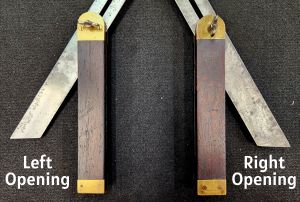
Bevels can open either to the left or the right as determined by the thumbscrew being at the top of the bevel and facing the user. The vast majority open to the left. Massachusetts makers open to the right, as well as the Cincinnati makers. Some very early S A Jones & Co bevels open to the right. One should be careful about this diagnostic, as on many bevels it is trivial for a previous owner to have reassembled the bevel with thumbscrew on the wrong side. Always investigate the top plates for evidence that it has been switched. This can include modifications to the holes the bolt passes through, or circular wear marks where the thumbscrew previously rotated. If you find a truly right opening bevel, that is a great help, as it really narrows down the number of possible makers.
9 - Blade Hub
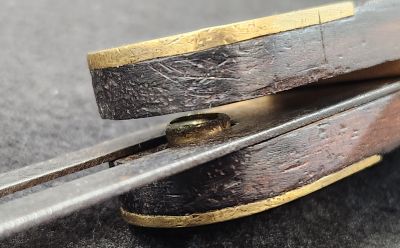
Blade hubs are an uncommon feature where the threaded portion of the back plate extends up into the blade kerf. The slot in the blade is wider than normal for the blade to ride around this hub. The advantage of this design is the blade does not deform the threads of the thumbscrew. This feature is known on most New York makers and two Philadelphia makers (Johnson & Conaway, J Nichols).
Regional Notes
The vast majority of bevels found will have been made in either Connecticut or Philadelphia. These regions were the most prolific, measured both by number of different makers and by total output. Thankfully their bevels are very different from each other and there is little chance of confusion. Following these two regions, Massachusetts made bevels are then the easiest to find. Cincinnati/Newport is next, although these seem to be easier to find the closer you are to their point of origin. They appear to have been sold more regionally while the big east coast makers dominated the national supply routes. Finally, the hardest to find are New York bevels. Illustrating this fact; while I have hundreds of bevels in my collection, only two are from New York, and I only know of a handful more.
Massachusetts
There are only three known Massachusetts bevel makers. Although there is no primary source documentation that they were partners, Henry Tower and John Barton’s bevels are identical to each other. Their bevels seem to always be marked as well, although many times with a very light stamp. The other maker is Lacy & Bullock, which other than their stamp are very similar to Tower and Barton. Their consistent features, and right-hand opening make Massachusetts bevels easy to identify.
Connecticut
As one of the major centers of bevel production, the sample size for Connecticut is deep and wide. Their consistency makes Connecticut bevels easy to attribute. One-piece handles and short top plates are hallmarks of Yankee practicality. Connecticut bevel design can be split into two distinct groups. Hartford maker S A Jones & Co and New Britain maker Hall & Knapp/Stanley used only wing nuts and top plate screws. The myriad of Middletown makers and The Standard Rule Co in Unionville used either wingnuts or round thumbscrews, but never any top plate screws. Their tops plates are also short like Massachusetts. Tidgewell & Co is alone in using both round thumbscrews and wingnuts.
New York City / Newark
With only a handful of known examples across four makers, New York bevels are the hardest to pin down. Exercise caution when attributing to New York as the sample sizes are just so low at this point. While three makers are relatively consistent, A & E Baldwin’s known bevel uses a steel wingnut on a 1.0 ratio top plate. Several slotted screw locking bevels are also known and not included in this study, as they represent early English design influence rather than the homegrown American style.
Philadelphia / Trenton
Philadelphia bevels are for the most part instantly recognizable. Two-part handles, medium length screwed top plates, and oval knurled thumbscrews are the hallmarks of Philadelphia bevels. The lone Trenton maker (S Kennedy) started in Philadelphia, so his bevels follow their style. A single maker, Charles Markland, stands out for using wing nuts. A handful of makers made all or some or their bevels with blind top plates, but these bevels are in the minority. The vast majority of Philadelphia bevels one will come across with have top plate screws.
Cincinnati / Newport
Many of the makers in Cincinnati, OH seem to have gotten their start working with C G Siewers at some point. Because he was the first documented maker in Cincinnati, it makes sense that his bevels set the regional style. Newport, KY (directly across the river from Cincinnati) bevels were also made by Siewers. There is some variation though, with both blind and screwed top plates are known, although blind seems more common. Top plates are usually the tallest of all bevels, but some shorter ones are known. Blades open to the right. The oval brass thumbscrew is often also quite thick.